
Why add the side trips?
Most people who book this version do it for Manaslu Base Camp, and that is a good enough reason on its own. Standing at about 4,800 m under the north face of the eighth-highest mountain in the world is the single best thing on this trek that is not the pass itself.
The reason we push it, though, is duller and more useful: it is the best-acclimatised itinerary we run on this route. The two days you add are not sightseeing days bolted onto a finished trek. They sit in the middle of the ascent, at Samagaun and at Samdo, in exactly the band where your body needs the time, and each of them is a walk high and sleep low day rather than a rest day in a lodge.
The 14-day circuit already meets the standard acclimatisation guidance everywhere except the Samdo to Dharamsala night, where there is simply nothing to sleep in between. This version does not fix that night, because nothing can. What it does is arrive at it with four more days of adaptation behind you.
- A full day to Manaslu Base Campat about 4,800 m, higher than anything else before the pass
- Birendra Lake and Pungyen Gompa on the standard Samagaun rest day, rather than an afternoon in a lodge
- A second night at Samdo, with the walk towards the Rui La on the Tibetan border at 4,998 m
- No extra permit. The whole area is already inside your restricted-area permit and MCAP
The 16-day itinerary, day by day
The route is the classic circuit. The only changes are day 8 and day 10, and both are spent at an altitude you have already slept at.
| Day 1 | Kathmandu → Machha Khola (930 m), 8–9 h by jeep |
|---|---|
| Day 2 | Machha Khola → Jagat (1,340 m) |
| Day 3 | Jagat → Deng (1,860 m) |
| Day 4 | Deng → Namrung (2,630 m) |
| Day 5 | Namrung → Lho (3,180 m) |
| Day 6 | Lho → Samagaun (3,530 m) |
| Day 7 | Samagaun, acclimatisation: Birendra Lake and Pungyen Gompa |
| Day 8 | Samagaun → Manaslu Base Camp (about 4,800 m) → Samagaun |
| Day 9 | Samagaun → Samdo (3,875 m) |
| Day 10 | Samdo, acclimatisation: towards Rui La (4,998 m) and back |
| Day 11 | Samdo → Dharamsala, also called Larkya Phedi (4,460 m) |
| Day 12 | Larkya La (5,106 m) → Bimthang (3,720 m) |
| Day 13 | Bimthang → Dharapani (1,860 m) |
| Day 14 | Dharapani → Besisahar → Kathmandu by jeep |
| Day 15 | Kathmandu, spare day and weather buffer |
| Day 16 | Departure |
Days 1 to 6: the walk in, unchanged
Identical to the classic itinerary: the jeep to Machha Khola, then five days up the Budhi Gandaki through the gorge, Deng, Namrung and Lho, with Manaslu appearing behind the village rooftops at Lho. Everything on the 14-day itinerary page applies day for day.
Day 7: Samagaun, Birendra Lake and Pungyen Gompa
This is the acclimatisation day the classic itinerary already has. The difference is what you do with it. Rather than a short walk above the village and an afternoon indoors, you take the two shorter side trips, both of which are gentle enough to leave you fresh for Base Camp the following morning.
Your guide will decide the order on the morning, based on the weather and on how the group slept. If anyone is struggling with the altitude, the whole day becomes a genuine rest day and Base Camp is reassessed the next morning. That call is the guide's and it is not negotiable.
Day 8: Manaslu Base Camp, about 4,800 m
The big day, and a proper one: four to six hours up and rather less back down, on moraine and glacial ground that is rough rather than technical. You gain roughly 1,270 m from Samagaun and lose it again the same day, sleeping back down at 3,530 m.
That shape is the point. A day walk to 4,800 m followed by a night at 3,530 m is worth more to your acclimatisation than a night spent 300 m higher up the valley, and you get the north face of Manaslu and the glacier out of it.
It is a long day and we do not pretend otherwise. Anyone who would rather not do it stays at Samagaun with a second rest day, which costs nothing and is a perfectly good use of the time.
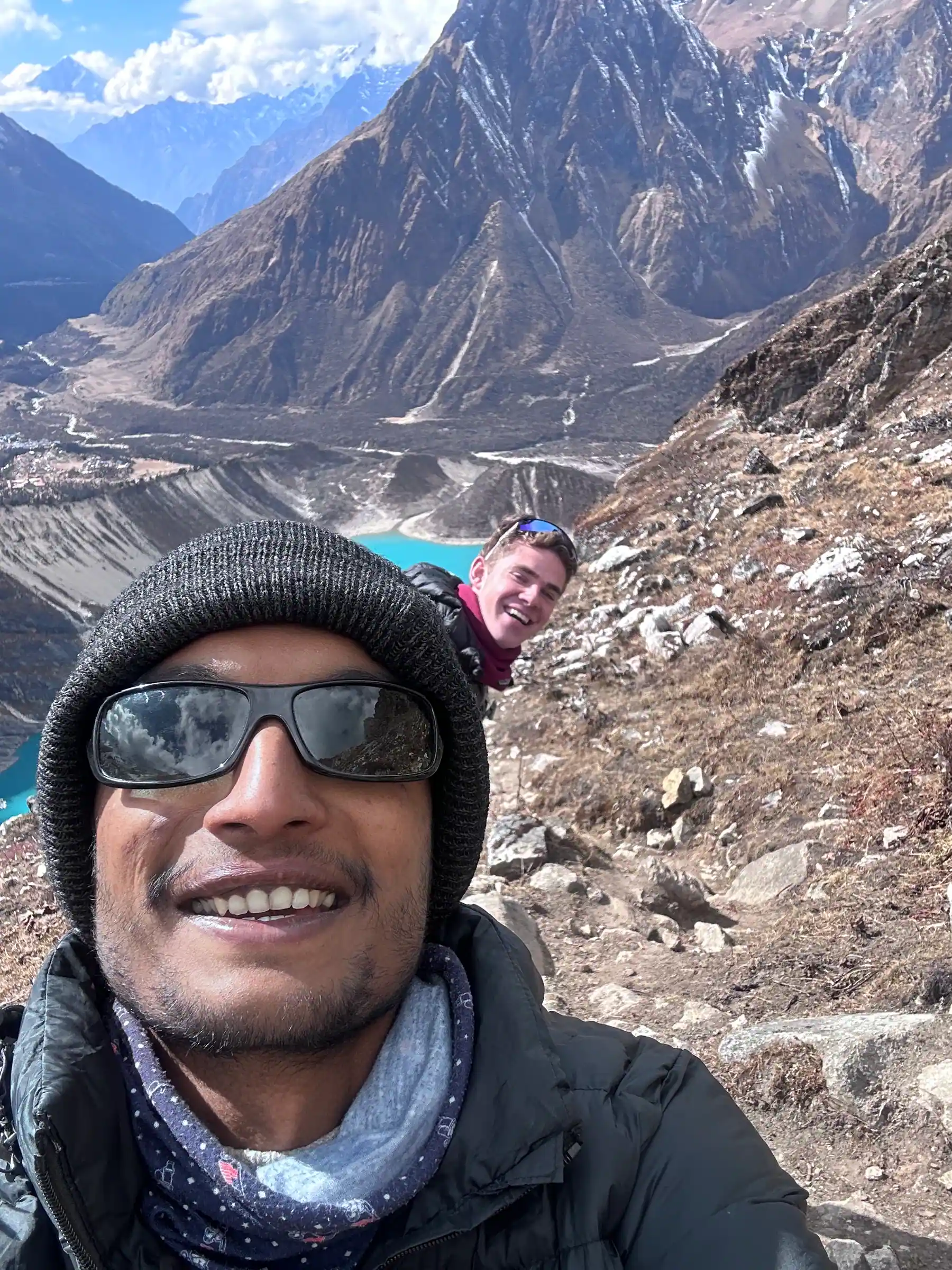
Day 9: Samagaun to Samdo, 3,875 m
A short day, deliberately. Three to four hours up the valley to Samdo, the last permanent village on the route, settled by Tibetan refugees in the 1960s and still trading north over the border.
Day 10: towards Rui La, 4,998 m
About three hours above Samdo on an old trading route that is still walked by the villagers, up to the pass into Tibet at 4,998 m. You cannot cross, and you should not try. You can stand on it, look down the far side, and come back.
At almost 5,000 m this is the closest you will get to Larkya La before you have to cross it, and it is the best preparation available anywhere on the route. Two days later you do the real thing.
Days 11 to 16: the pass and out
From here the trip is the classic circuit again: up to Dharamsala, over Larkya La at 5,106 m and the long descent to Bimthang, then down the valley to Dharapani and the jeep back to Kathmandu, with a spare day before you fly.
The spare day stays. It is the weather buffer for the pass, and adding side trips is not a reason to spend it.
The side trips, honestly compared
All four are inside the area your existing permits already cover. They differ a great deal in how hard they are.
Manaslu Base Camp, about 4,800 m
The hardest of the four and the reason most people book this version. A full day from Samagaun, four to six hours each way, over moraine and glacial ground. It needs the acclimatisation you will have by day 8 and it needs a settled morning.
We will not schedule it on the day before the pass, and we would be wary of any operator who did. On this itinerary it sits four days before Larkya La, which is enough for the benefit to arrive and the fatigue to clear.
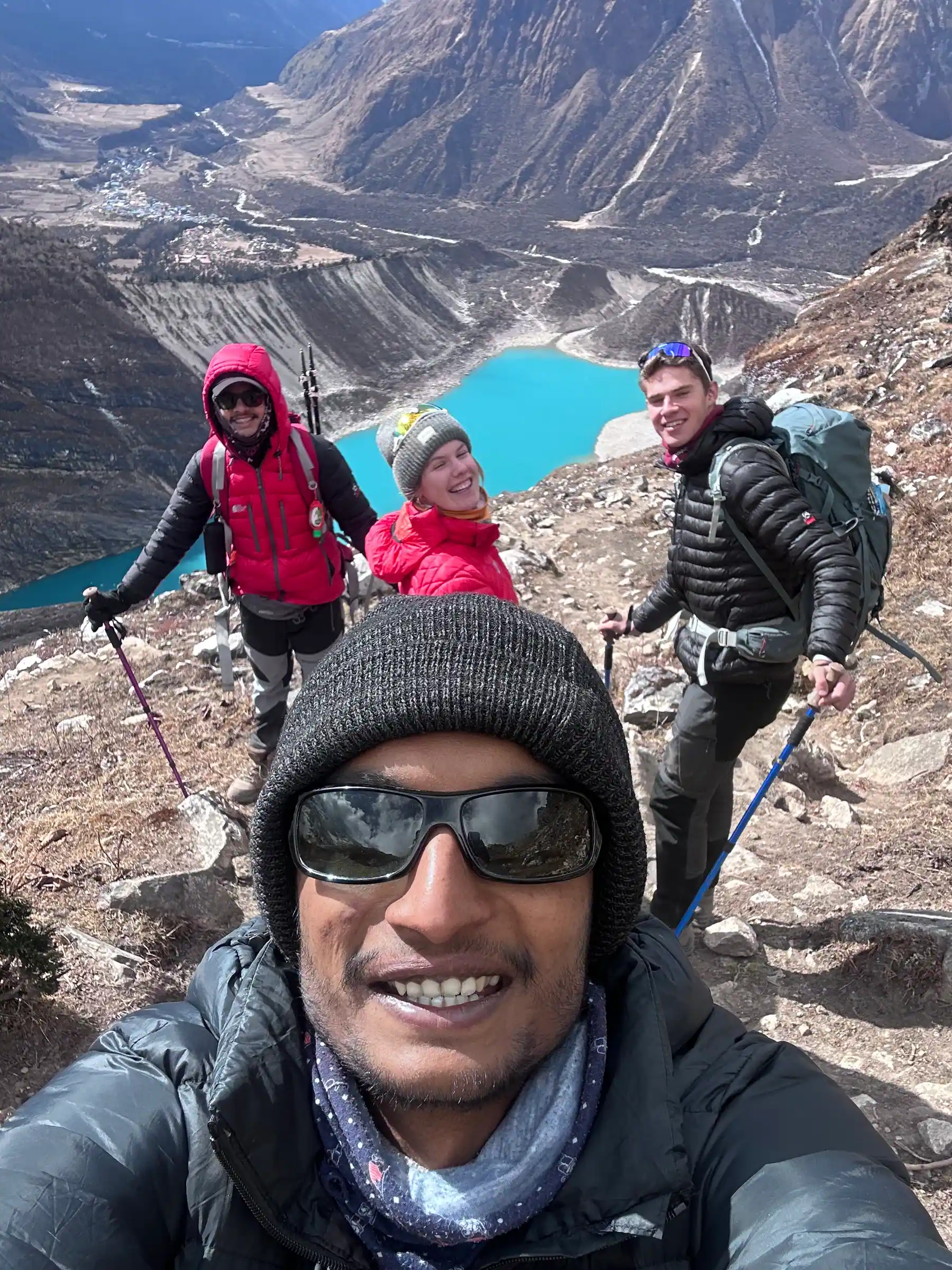
Birendra Lake
A glacial lake just above Samagaun, fed straight off the Manaslu glacier, an hour or two each way on an easy trail. Published altitudes for it vary between about 3,450 m and 3,690 m depending on the source, and we have not measured it ourselves, so treat any precise figure with suspicion. What is not in doubt is that on a clear morning Manaslu sits in the water.
Pungyen Gompa, around 3,800 m
A Tibetan Buddhist monastery on a ridge above Samagaun, said to be more than four centuries old, and said locally to stand on the site used as the original Manaslu base camp. The name comes from a local term for three peaks. Roughly an hour to an hour and a half up from the village, with a view back over the upper Budhi Gandaki that is one of the best on the trek.
Rui La, 4,998 m
The Tibetan border pass above Samdo, about three hours up. Not scenic in the way the others are, and that is not why it is on the list. It is here because it is the highest ground you can reach and sleep below before the pass.
Why this is the safest version we run
The standard guidance above 3,000 m is to raise your sleeping altitude by no more than about 500 m a day, with a rest day roughly every 1,000 m. Both itineraries respect that everywhere except the Samdo to Dharamsala night, where the 585 m gain is unavoidable because there is nothing to sleep in between.
What changes on this version is everything leading up to it:
- Two nights at Samagaun instead of one, with a day walk to 4,800 m between them
- Two nights at Samdo instead of one, with a day walk to 4,998 m between them
- You reach Dharamsala having twice been higher than you are about to sleep, which is not true on the 14-day version
This is the itinerary we recommend to anyone who has had altitude symptoms before, anyone who has not been above about 4,000 m, and, on average, to trekkers in their sixties and seventies, for the reasons set out in our difficulty and fitness guide. It is also the one to take if crossing the pass matters a great deal to you, because the commonest reason people do not cross is not fitness or weather, it is arriving at Dharamsala under-acclimatised.
None of this makes altitude illness impossible. Read the altitude sickness page before you book, whichever version you choose.
What the two extra days cost
From £1,420 per person, two sharing, all-inclusive from Kathmandu: guide, porter, all permits, teahouse accommodation throughout, three meals a day on the trail and all ground transport. That is £125 more than the 14-day circuit.
You need no additional permit. Base Camp, Birendra Lake, Pungyen Gompa and Rui La are all inside the ground your Restricted Area Permit and MCAP already cover. The extra cost is two more days of guide, porter and lodges, plus two more days on the restricted permit, which is the one fee on this trek charged by the day rather than by the trip.
It is the cheapest way to add a serious objective to this trek, because it uses the lodges and the staff you were already paying for. Full breakdown on the cost page.
