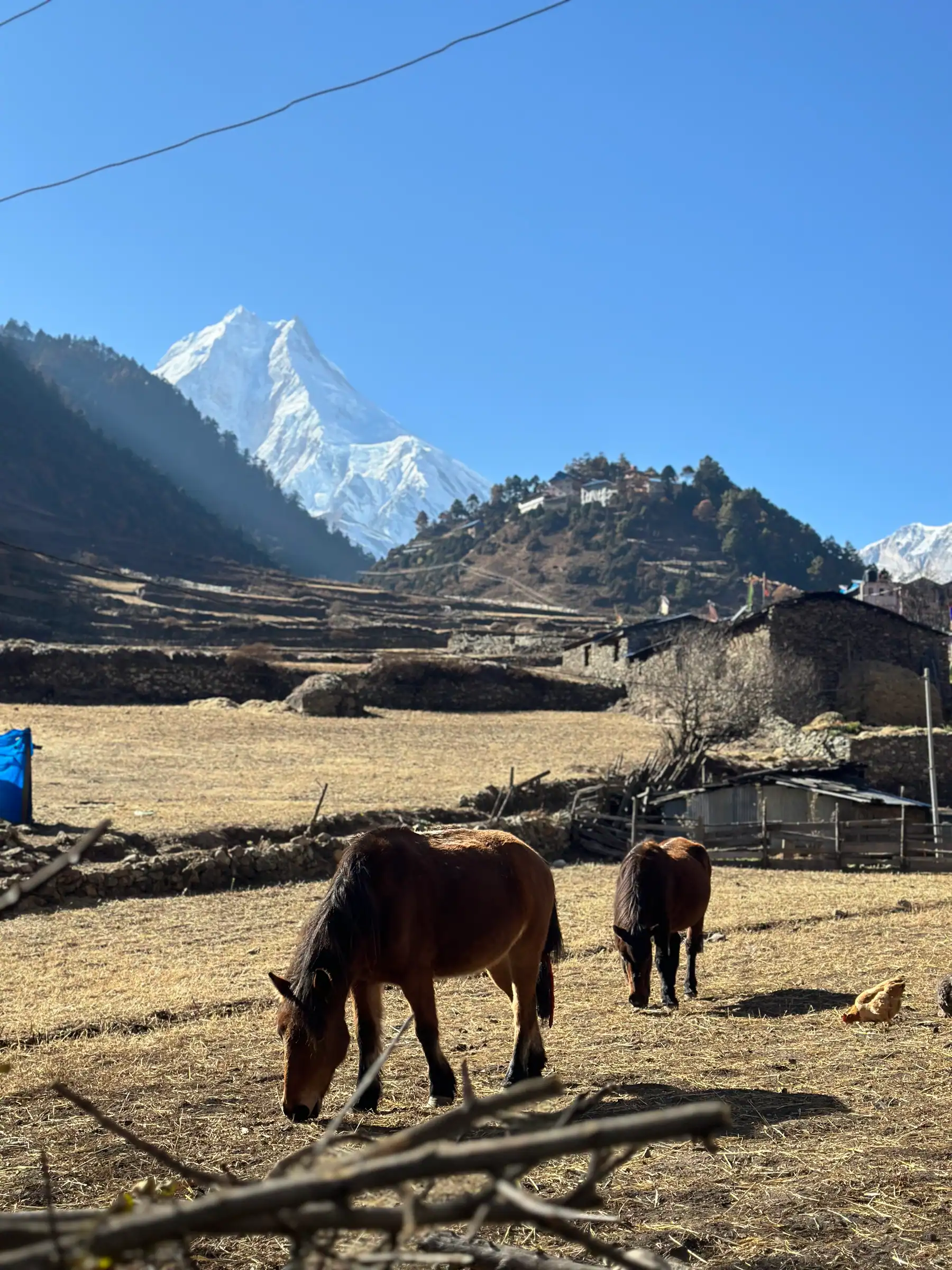
How hard is the Manaslu Circuit? The short answer
The Manaslu Circuit is challenging, a grade harder than the Annapurna Circuit. On the classic 14-day trip you walk on ten of those days, typically four to eight hours a day and up to ten on the pass, gaining somewhere between 350 m and 800 m most days, and you cross Larkya La at 5,106 m once. There is no technical climbing, no ropes, no crampons, no scrambling in normal spring or autumn conditions. It is a long walk at height.
The honest version: a fit UK hill-walker will find the walking well within reach and the altitude the only real unknown. Someone who does not walk regularly will find days six through ten a grind, and the pass day genuinely hard. Neither group is at any technical risk; the difference is how much of the trek they enjoy.
What makes the circuit harder than its individual days suggest is accumulation. One seven-hour day with 800 m of ascent is an ordinary weekend in the Lake District. Nine of them in a row, sleeping progressively higher, eating unfamiliar food and not sleeping well above 4,000 m, is a different proposition, and it is the one you should train for.
| Grade | Moderate to challenging |
|---|---|
| Technical difficulty | None in normal conditions: a walk, not a climb |
| Typical walking days | 9–10 on the classic 14-day trip |
| Hours a day | 5–8 moving, plus stops |
| Daily ascent | Commonly 350–800 m |
| Highest point | Larkya La, 5,106 m |
| Highest night | Dharamsala / Larkya Phedi, 4,460 m |
| Biggest single descent | −1,386 m, pass to Bimthang |
| What you carry | Daypack only, 5–8 kg: a porter takes the rest |
| Hardest day | The Larkya La crossing, by a distance |
What "moderate to challenging" means in UK terms
Trek grades are close to meaningless across operators: one company's "moderate" is another's "strenuous". So here is the circuit translated into things a British walker already knows.
- A typical circuit day is a big Lake District day.Think Wasdale to Scafell Pike and round to Great Gable, or the Fairfield Horseshoe at an unhurried pace: six to seven hours, 800–900 m of ascent, rough underfoot in places.
- A hard circuit day is a long Snowdonia or Cairngorms day.The 22 km from Machha Khola to Jagat, or the 25 km descent from Bimthang to Dharapani, would sit comfortably in that category on their own.
- The whole trek is closer to a Pennine Way stretch than a single mountain day.Ten consecutive days at an average of 16 km is the defining feature, and it is exactly what a Coast to Coast or a long Pennine section trains you for.
- The pass day has no UK equivalent.Partly because there is nowhere in Britain to practise being at 5,100 m before dawn in −15 °C, and partly because the descent alone, 1,386 m in one go, is more than Ben Nevis from the summit to the sea, done at the end of a ten-hour day.
Set against the other big Nepal treks, Manaslu sits at the hard end of the teahouse routes. It is harder than the Annapurna Circuit, despite the pass being 310 m lower, because the days are longer, the lodges are plainer and there is no road through the middle of it to shorten a bad day. It is comparable to Everest Base Camp in overall demand: EBC sleeps higher for longer, Manaslu is longer, remoter and harder to leave. The full comparison is on our which-trek comparison page.
Daily demands: hours, ascent and what you actually carry
This is the classic 14-day shape. Days vary by an hour either way depending on group pace, and the guide adjusts as the week goes on.
| Day | Section | Hours | Net height change | How it feels |
|---|---|---|---|---|
| 1 | Kathmandu → Machha Khola (930 m) | Drive day | n/a | Long on the road, easy on the legs |
| 2 | Machha Khola → Jagat (1,340 m) | 6–7 | +410 m | Warm, humid, 22 km with a lot of up and down in it |
| 3 | Jagat → Deng (1,860 m) | 6–7 | +520 m net | Modest net gain, a great deal of climbing and dropping |
| 4 | Deng → Namrung (2,630 m) | 6–7 | +770 m | The biggest ascent day of the trek, taken while it is still safe to |
| 5 | Namrung → Lho (3,180 m) | 4–5 | +550 m | Short, and the day Manaslu finally appears |
| 6 | Lho → Samagaun (3,530 m), then the acclimatisation day | 4, then 4–7 | +350 m, then climb to 3,900–4,800 m and sleep low | A rest day that is not restful, deliberately |
| 7 | Samagaun → Samdo (3,875 m) | 3–4 | +345 m | Short and slow; everything above here is slow |
| 8 | Samdo → Dharamsala (4,460 m) | 3–4 | +585 m | Short hours, hard work, and a cold night in a hut with no village round it |
| 9 | Larkya La (5,106 m) → Bimthang (3,720 m) | 8–10 | +646 m then −1,386 m | The hardest day of the trek, by a distance |
| 10 | Bimthang → Dharapani (1,860 m) | 7–8 | −1,860 m over 25 km | All downhill, all lovely, and much longer than people expect |
What you carry
On a guided trip, a shared porter carries up to 24 kg between two trekkers, which in practice means a duffel of about 12 kg each. You carry a daypack of 5–8 kg: water, waterproofs, an insulating layer, camera, snacks, sun cream, personal medication and your documents. On pass day it is heavier, because you start in everything and shed layers as the sun comes up.
Train with the daypack, not without it. Five kilograms sounds trivial and changes your gait, your shoulders and your descent balance over seven hours. The packing list sets out what belongs in the daypack and what goes in the duffel.
Terrain underfoot
Mostly good stone-and-dirt trail, well-graded because it has been a trading route to Tibet for centuries. The exceptions worth knowing: steep, loose moraine for the first hour below the pass, which holds old snow and ice into the spring; a long knee-punishing descent to Bimthang after it; and gallery-cut sections in the Budhi Gandaki gorge where the path is carved into the rock above the river with a long drop below. Trekking poles are genuinely useful on this trek, not an affectation.
The Larkya La day: the hardest day, and why
Everything about the circuit's difficulty concentrates into one day. You wake at 03:15 at Dharamsala after a night at 4,460 m at which almost nobody sleeps properly, in a hut with no heating and thin blankets, eat porridge in the dark, and set off by head torch at around 04:00 in −5 °C to −15 °C.
The climb is 616 m over roughly four hours, a gradient that would take a couple of hours at sea level. It goes slowly because you are above 4,600 m and each breath delivers roughly half the oxygen it would at home. Then, after fifteen minutes at the cairn, you descend 1,386 m over about 12 kmto Bimthang, which takes four hours or more and does far more damage to most people's legs than the climb does to their lungs.
The descent is the part people undertrain for, and on Manaslu it is worse than on any other teahouse route in Nepal. Ankle and knee injuries on the Bimthang side are the most common reason a Manaslu trip needs outside help, more common than altitude evacuations, and they almost all happen in the last two hours when concentration has gone. If you do one thing differently in training, add deliberate descent work.
The full hour-by-hour account of the crossing, the turn-around protocol and when we do not cross at all is on the Larkya La pass guide.
Altitude is not a fitness problem, and this matters
The most common misunderstanding we meet is the belief that being fit protects you from altitude sickness. It does not. Susceptibility to acute mountain sickness is largely independent of aerobic fitness, and a strong walker who charges ahead is at more risk than a slow one who does not, simply because they ascend faster.
What fitness does buy you at altitude is margin. A fit trekker walks the pass at a comfortable, sustainable pace, arrives with reserves, eats properly, and descends safely. An unfit trekker arrives at the cairn empty and then has to do the hardest five hours of the trek on nothing. Fitness changes everything about the day except the physiology of acclimatisation.
Because altitude is the separate variable, we treat it separately: a compulsory rest day at Samagaun, daily pulse oximetry above 3,000 m, and a willingness to change the plan. All of that is set out in the Manaslu Circuit altitude sickness guide, which is the page to read if the altitude is what worries you rather than the walking.
Am I fit enough? A UK hill-walking test
Forget VO2 max and gym benchmarks. Here is a test you can actually do on a British weekend, and it is the one we use when someone asks us this question over WhatsApp.
The details matter more than the headline:
- Two consecutive days, not one. Anybody can have one big day. The circuit asks for nine. Back-to-back is the part that tests recovery, which is the actual limiting factor.
- With the pack. Five kilograms, the weight you will carry. Not a bum bag.
- Real ascent.Flat canal-path miles do not prepare quadriceps and calves for 800 m of climbing.
- And real descent. If your test route goes up a hill and down a road, it is not testing the thing that hurts on the Bimthang side.
- The third morning is the test. Stiff is fine. Unable to face a third day is a signal to train more, not a signal to cancel.
Suitable UK test routes: the Fairfield Horseshoe two days running, the Snowdon Horseshoe followed by the Glyderau, Ben Lomond and then the Cobbler, or two consecutive Pennine Way day stages with a pack. If you live somewhere flat, two long days on the South Downs Way with a heavier pack is a reasonable substitute. You will get the hours and the cumulative fatigue if not the vertical.
If you can't do that yet
That is a training problem, not a verdict. Most people who ask us this question are eight to twelve weeks of consistent walking away from the benchmark. The plan below is what we send them.
An eight-week training plan before you fly
Built for UK conditions and a normal working week. Nothing here needs a gym membership, though one helps for the strength work. If you already hill-walk most weekends, start at week four.
| Week | Midweek | Weekend | Focus |
|---|---|---|---|
| 1–2 | Two 45–60 min brisk walks; one session of stairs or hill repeats (20 min) | One 3–4 hr walk with a 4 kg pack | Habit and base. Break your boots in now. |
| 3–4 | Two 60 min walks; one strength session (squats, lunges, step-ups, calf raises) | One 5 hr hill walk, 500 m+ ascent, 5 kg pack | Leg strength and time on feet |
| 5–6 | Two 60–75 min walks; one strength session; one longer cardio session (cycle, swim or run) | Back-to-back:5 hr Saturday + 4 hr Sunday, 5 kg pack | Recovery between days, the key adaptation |
| 7 | Two 60 min walks; one strength session focused on eccentric (downhill) loading | The test:6–7 hrs Saturday + 6 hrs Sunday, 700–900 m ascent each day | Peak load and a genuine kit rehearsal |
| 8 | Two easy 45 min walks; light stretching | One easy 2–3 hr walk | Taper. Arrive fresh, not shattered. |
The four things that matter most
- Time on feet beats intensity. A slow six-hour walk prepares you for the circuit far better than a hard ninety-minute run. Trekking is a low-intensity endurance activity and should be trained as one.
- Train the descent deliberately.Downhill loading is eccentric and it is what wrecks quadriceps on the drop to Bimthang, and again the next day on the 25 km to Dharapani. Walk down the hills you walk up, add step-downs to your strength session, and use poles in training so they are automatic on the day.
- Break in the boots you are taking. Not new boots two weeks out. Thirty to fifty miles of walking in the actual pair, in the actual socks, before you fly. Blisters end more circuits than altitude does.
- Rehearse the whole kit once. Week seven, walk in the boots, socks, base layer, pack and poles you are flying with. Everything you discover then is a problem solved in the UK rather than at Deng, three days from a road.
If your departure is further out, stretch the plan rather than compress it: twelve or sixteen weeks at a gentler ramp beats eight weeks of rushing and an injury in week six.
Who should not attempt the Manaslu Circuit
We would rather say this now than at Samagaun, four days from a road. None of the following is an absolute bar, but each one needs a real conversation with your GP before you book, and in some cases a different trek.
- Significant cardiac or respiratory conditions.Angina, poorly controlled heart failure, severe COPD or pulmonary hypertension are serious concerns at 5,106 m, and more so on a route where the nearest road is two days away. This is a GP or specialist decision, not ours and not yours alone.
- Knees that already fail on descents.The 1,386 m drop to Bimthang is unavoidable, there is no vehicle option on it, and the following day is another 1,860 m down over 25 km. If a Lakeland descent already forces you to stop, this is the wrong trek before it is the wrong itinerary.
- No exercise baseline at all and a departure inside eight weeks. Going from a sedentary autumn to ten consecutive walking days is where people are genuinely miserable rather than merely tired, and here they cannot get in a jeep at the end of a bad one.
- Any condition where descent could be delayed or complicated: recent surgery, unstable diabetes, a condition needing refrigerated medication. Manageable with planning; unmanageable if not disclosed.
- Anyone unwilling to turn back.This is the honest one, and it matters more here than on any other teahouse route, because turning back at Dharamsala means three days down the valley rather than a short drive out. If crossing the pass matters more to you than the guide's judgement about whether to cross it, the circuit is the wrong trek.
If one of these applies, the answer is often a different itinerary rather than a different holiday. The 16-day side-trip itinerary adds acclimatisation and shortens the hardest days. If the descent is the problem rather than the altitude, though, no Manaslu itinerary fixes it, and the honest answer is a different trek: our Annapurna Base Camp trek tops out at 4,130 m with no pass at all, and the Annapurna Circuit has jeep roads at both ends.
Age: trekking the circuit in your 50s, 60s and 70s
We take trekkers in their sixties and seventies over Larkya La every season, and age on its own is a poor predictor of who has a good trek. What predicts it is recent walking history, joint health and any cardiac or respiratory condition, and a sixty-eight-year-old who walks three times a week will out-trek a thirty-five-year-old who has not been up a hill since university.
What does change with age, on average:
- Recovery between days slows. This is the strongest argument for the 16-day side-trip itinerary, which adds a second acclimatisation night and shortens two of the harder days.
- Descent tolerance drops before ascent tolerance does. Poles and a slower descent to Bimthang, planned rather than improvised. On this route that is the single most useful adjustment we make for older trekkers.
- Medication interacts with altitude.Diuretics, beta blockers and blood-pressure medication all deserve a conversation with your GP specifically about a trip to 5,106 m in a restricted area with no road access.
- Insurance costs more and caps sooner. Several UK policies price up or restrict cover past 65 or 70. Check the altitude limit and the age band together, before you book.
Tell us your age and walking history when you enquire, and we will tell you which itinerary we would actually put you on. Sometimes that is the 16-day. Occasionally it is a different trek. We would rather say so.
The part nobody trains for
Physical difficulty is the easy half of this page. The circuit is also two weeks of cold rooms, repetitive food, no hot water above Samagaun, no signal at all above it, and going to bed at eight because there is nothing else to do. Manaslu is plainer than the Annapurna trails in every one of those respects. Around day seven or eight a lot of trekkers hit a flat patch that has nothing to do with their legs.
Things that help, in our experience of watching several hundred people through it:
- Expect the day-seven dip and treat it as a normal part of the trek rather than a sign you have made a mistake.
- Eat more than you want to at altitude.Appetite falls above 4,000 m exactly when calorie demand rises. Dal bhat comes with refills for a reason.
- Accept that you will sleep badly at Dharamsala.Almost everybody does. Broken sleep at 4,460 m is not a warning sign on its own; it is what 4,460 m in an unheated hut feels like.
- Bring something to read that is not on a phone. Charging is metered above Namrung, solar and often marginal, and battery life is halved by the cold.
- Tell your guide when you are struggling. Not just about symptoms: about morale. Pace, route choice and the order of the day can all be adjusted, and none of it can be adjusted if nobody knows.
Manaslu Circuit difficulty FAQ
How hard is the Manaslu Circuit trek?
Is the Manaslu Circuit suitable for beginners?
Am I fit enough for the Manaslu Circuit?
What is the hardest day on the Manaslu Circuit?
Do I need to run to get fit for it?
Can you do the Manaslu Circuit in your 60s or 70s?
How much weight will I carry?
Does being fit stop altitude sickness?